Why We're Open-Sourcing Mushroom Cultivation

mbeacom
Author7 min read
mbeacom
Author7 min read
Today, I'm releasing something I've been building for two years: the WeMush Open Labeling Standard and the platform that uses it.
But before I explain what it is, let me tell you why it exists.

I spent six years in the Army and nearly two decades building cloud infrastructure and DevOps systems for some of the largest tech companies in the world. When I left that career to start growing mushrooms, I expected the hard part would be the biology.
I was wrong.
The hardest part was tracking data.
Which substrate recipe gave me the best yields? Why did this batch fail? How do I replicate my success? I had notebooks, spreadsheets, photos scattered across devices, and absolutely no way to answer basic questions about my own operation.
I'm a data engineer who spent years scaling systems at AWS and other tech companies. This drove me crazy.
So I built WeMush—a platform to track every specimen from culture to harvest. But as I talked to other growers, I realized something bigger:
We're all solving the same problem in isolation.
Every mushroom farm, every research lab, every home cultivator is independently tracking the same data. We're using incompatible systems, unable to share insights, unable to compare notes.
The mushroom industry is a $50 billion global market, and we're operating like it's 1950.
Today, we're releasing two things:
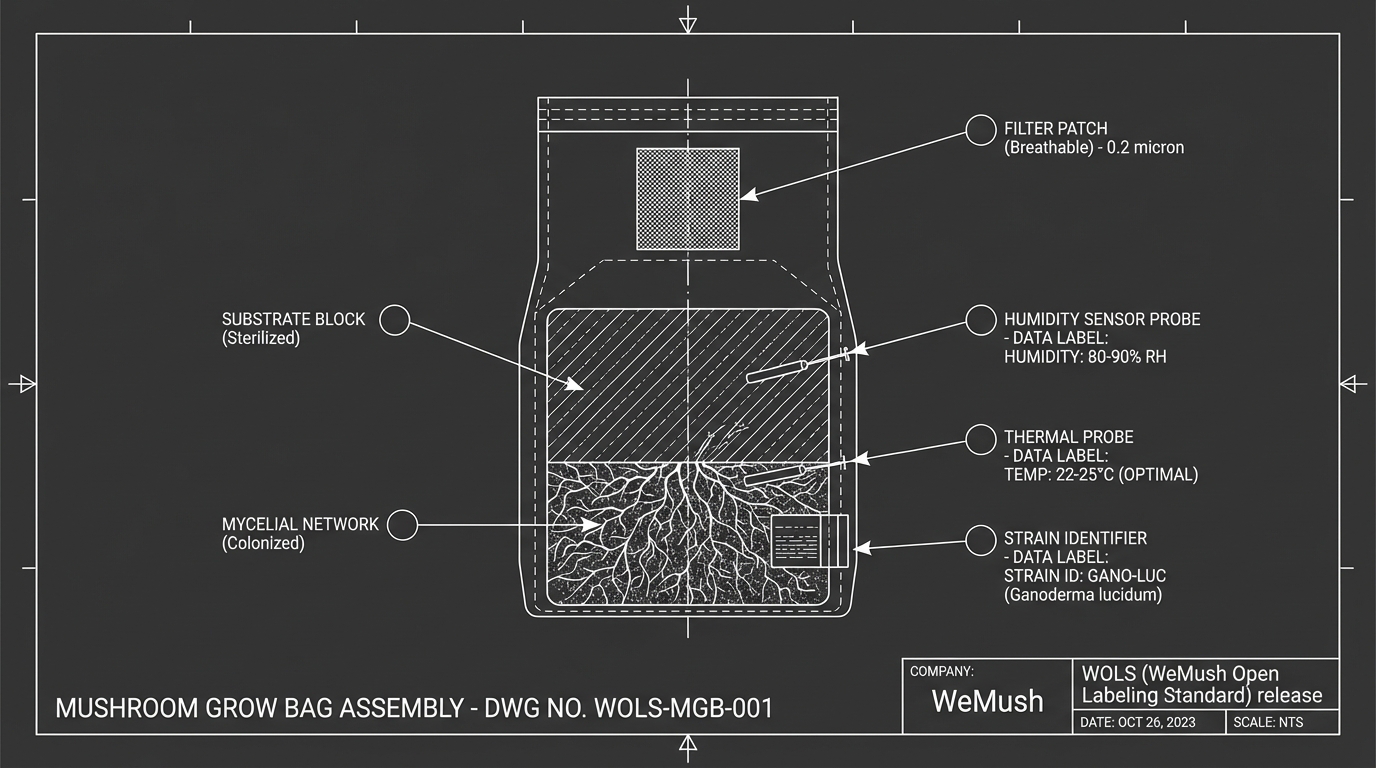
An open-source specification for encoding cultivation data in QR codes. It's like barcodes for the modern age—but for living organisms instead of products.
WOLS enables:
The spec is released under Creative Commons (CC BY 4.0). Anyone can use it, build on it, or extend it. No licensing fees. No vendor lock-in.
Read the full specification | GitHub repository
A research-grade cultivation management system that implements WOLS. Think of it as:
But it's more than tracking. The platform includes:
For Growers:
For Researchers:
For Circular Economy:
The platform is free during beta. We're looking for growers, researchers, and organizations to test it and help shape what comes next.
I know what you're thinking: "Why give away your competitive advantage?"
Three reasons:
Look at the internet. HTTP, HTML, TCP/IP—all open standards. They enabled a trillion-dollar economy because they were open.
If we want mushroom cultivation to become a major sustainable food source, we need infrastructure. We need standards. We need interoperability.
I'm not giving away competitive advantage. I'm building the foundation that makes competition possible.
The smartest people in mushroom cultivation don't work for me. They're running farms in Oregon, researching in universities, growing in basements across the world.
If WOLS becomes the standard, I get access to a global brain trust. The collective improvement of the standard benefits everyone—including WeMush.
This is the open-source model that made Linux, Wikipedia, and the web successful. It works.
As a disabled veteran and Farmer Veteran Coalition fellow, I've seen firsthand how veterans struggle to find purpose after service.
Agriculture—especially sustainable agriculture—offers that purpose. But the barriers to entry are high.
WeMush lowers those barriers. The open standard ensures no single company controls access to cultivation knowledge.
If another company builds better tools using WOLS, good. That means more veterans have better resources to start farms.
This is the beginning, not the end.
Short-term (Q1 2026):
Medium-term (2026):
Long-term (2027+):
For the engineers reading this:
Backend: Next.js 16, TypeScript, Prisma ORM Database: PostgreSQL (with PostGIS for location data) Infrastructure: AWS, Vercel, GCP ML/AI: Python microservices, TensorFlow for forecasting, image analysis, and anomaly detection Mobile: React Native (coming soon) IoT: MQTT protocol, edge computing for sensors
Everything is API-first. Everything is designed for scale.
We're looking for three types of people:
If you grow mushrooms—commercially or at home—we want you. Requirements: Willingness to log at least 5 grows over 90 days You get: Free platform access, influence on roadmap, early access to features Apply for beta
If you're a developer, designer, or data scientist interested in ag-tech:
If you're an equipment manufacturer, supplier, or organization:
Leaving a successful tech career to grow mushrooms was the scariest decision I've made since joining the military.
I had spent nearly two decades building the infrastructure that powers the modern internet—from cloud platforms to DevOps systems at companies like AWS. I had expertise, stability, and a clear path forward.
I gave it up to play in dirt and build software for an industry most people don't think about.
But here's what I've learned: The best technologies solve real problems for real people.
I built WeMush because I had a problem. I'm releasing it open-source because thousands of other growers have the same problem.
If you're one of them, I'd love to hear from you.
If you're not, but you know someone who is, please share this.
And if you're a veteran thinking about farming, reach out. Let's talk.
About the Author:

Mark Beacom is a disabled veteran (US Army, 2006-2012), former cloud infrastructure and DevOps architect with nearly 20 years of experience at companies including AWS, and founder of WeMush. He's a 2025 Farmer Veteran Coalition Fellow and EU-US TSTI Fellow for agricultural innovation. He grows mushrooms in Ohio and thinks too much about data.
We'd love to hear your thoughts:
Join the discussion on GitHub Discussions.
Related Reading: