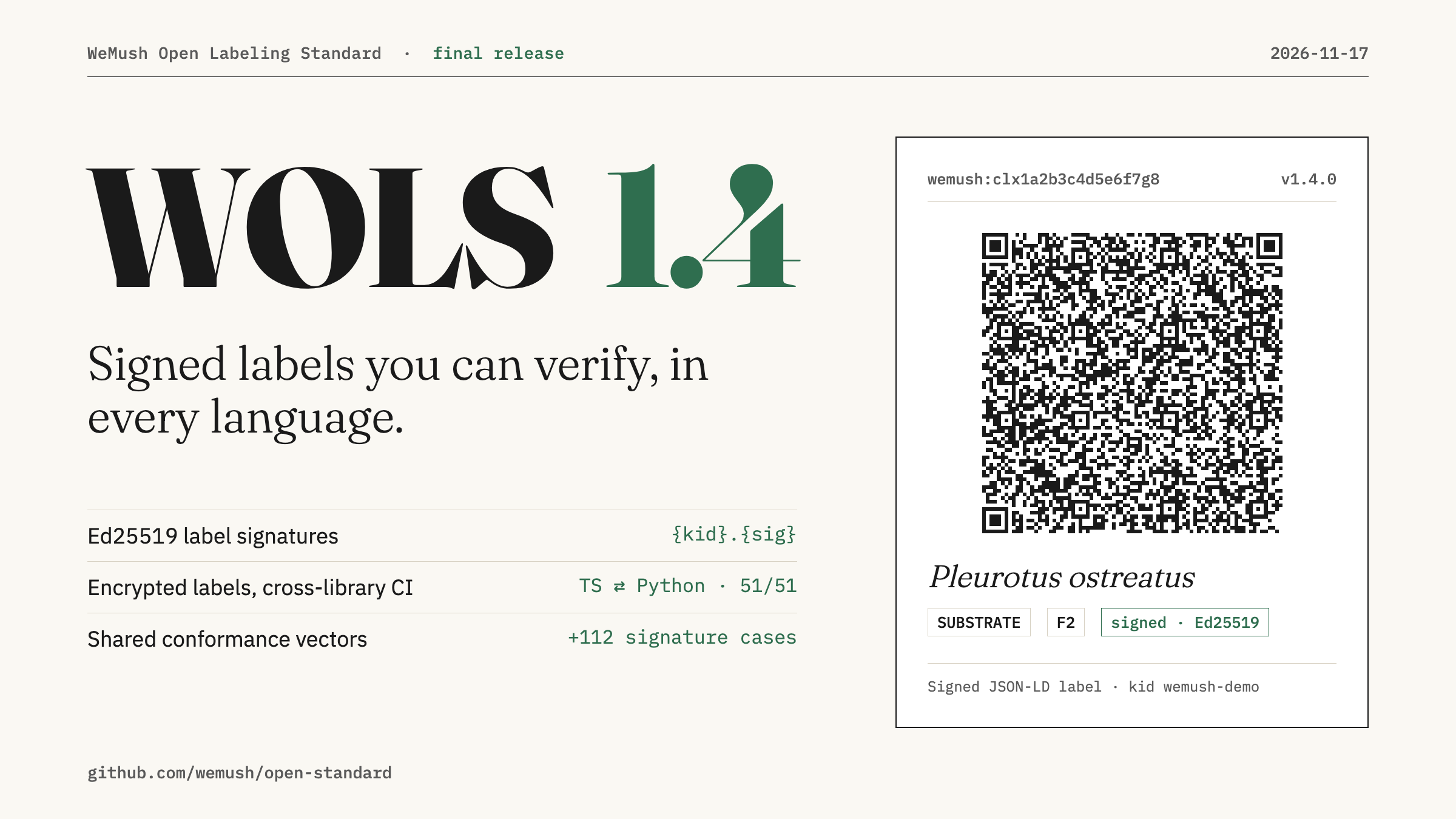
WOLS v1.4.0 adds Ed25519 signatures to the encrypted label format that v1.3.0 fully specified. Both reference libraries pass every conformance vector and decrypt each other's labels in CI. Upgrading from 1.2 includes breaking changes for encrypted labels; read before upgrading.
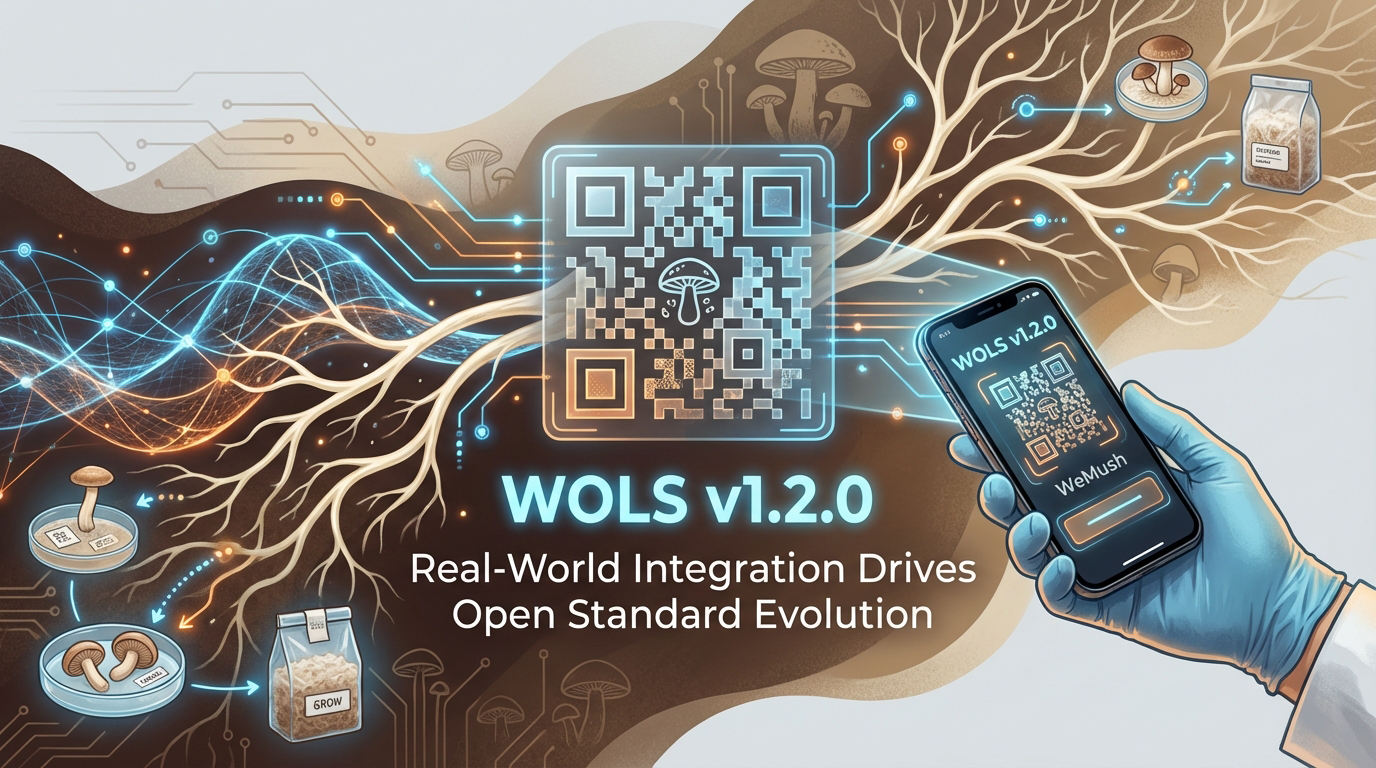
WOLS v1.2.0 brings flexible ID validation, type aliases, expanded growth stages, and migration utilities—all driven by production integration feedback from the WeMush platform.
WOLS v1.1 adds clonal generation tracking to monitor culture health over transfers, adopts JSON-LD for interoperability with agricultural data systems, and ships production-ready Python and TypeScript libraries. The spec is CC 4.0. The tooling is Apache 2.0. Both are free forever.
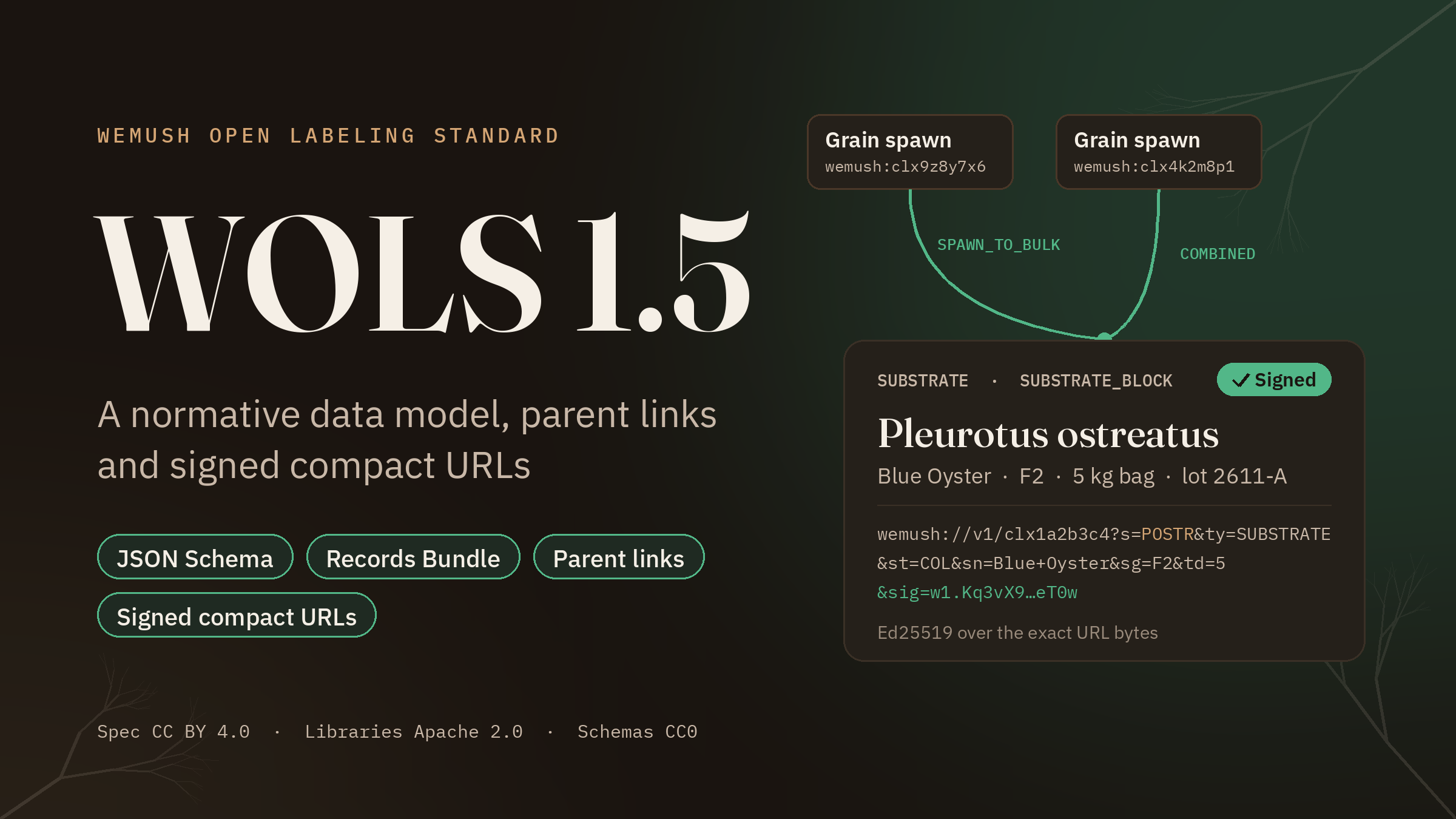
Today we're releasing WOLS v1.5.0. v1.4.0 made labels you can trust. v1.5.0 makes labels that say more and mean the same thing everywhere. The headlines: a JSON Schema now defines every label member, a label can name all of its parents and how each was used, a Records Bundle carries the history a label can't hold, and compact URLs, the short form on small QR codes, finally decode the same way in every implementation and can be signed.
This release includes:
WOLS Specification v1.5.0, the open standard itself
@wemush/wols v1.5.0, the TypeScript/JavaScript library
wols v1.5.0, the Python library
Upgrading from 1.4? Every 1.4 label stays valid and decodes the same way, as long as its created has a time zone. The 1.4 libraries read 1.5 labels but drop the new members when they re-save one, so upgrade every scanner and reader before you print labels that use them. See Upgrading from 1.4.
What's WOLS?
New to WOLS? Expand for background.
WOLS (WeMush Open Labeling Standard) is an open specification for encoding specimen data in QR codes and digital labels for mushroom cultivation and research. It lets growers, researchers, and labs share specimen data in a standardized, interoperable format, regardless of which software they use.
The specification is open source under CC BY 4.0, the official libraries are Apache 2.0, and the JSON Schemas are public domain (CC0).
The first was the data model. The prose said what a label holds, but not always what was required, and there was nowhere to put things growers track every day: a bag made from two spawn jars, a culture that got contaminated, the jar or bag a specimen lives in, or the lot code on a package you sell. Each system improvised, usually with custom fields or by bending a growth stage to mean "contaminated".
The second was compact URLs. They're the format small labels use, and the two reference libraries wrote them differently. They used different species codes, read different parameters, and accepted different mistakes. Because the parameters weren't normative, 1.4.0 couldn't sign a compact URL at all.
v1.5.0 closes both. It went through two release candidates on the way: 1.5.0-rc.1 for the data model and 1.5.0-rc.2 for compact URLs and their signatures. The final release adds no normative changes beyond rc.2.
What's New
1. A Normative JSON Schema
In plain terms: there is now one exact, machine-checkable definition of a valid label. If your tool says a label is valid, every other WOLS tool agrees.
schema/1.5/label.schema.json defines the embedded label, and bundle.schema.json the Records Bundle. Both are JSON Schema 2020-12 and are served at their $ids under https://wemush.com/wols/schema/1.5/. Where the schema and the prose differ, the schema wins.
What the schema settles, for implementers.
Required: @context, @type, id, version, type and species. Everything else is optional, including stage, created and strain.name, so you can record generation and transferDepth for a strain that has no name.
version is MAJOR.MINOR.PATCH, with an optional pre-release suffix such as 1.5.0-rc.2.
created, when present, is an RFC 3339 date-time with an offset. A date without a time is invalid.
Unknown members are kept. Decoders keep every member they don't recognize, and a signature member exactly as it is, and write them back unchanged. A 1.5 reader never silently loses data that a newer writer added.
_meta keys are written in camelCase (sourceId, sourceSystem, importedAt, schemaVersion). Decoders accept the snake_case keys that Python wols 1.4.0 wrote.
Sync rule: each reference library's tests validate every conformance vector against the schema and fail if the schema's verdict differs.
2. Parents, Taxon, Form, Condition, Container and Lot
In plain terms: a label can now say what it was made from, exactly what organism it is, what physical form it takes, whether it's healthy, what it's in, and which sellable lot it belongs to. All of these are optional.
Member
What it records
derivedFrom
Every parent specimen, how it was used (SUBCULTURE, EXPANSION, SPAWN_TO_BULK, COMBINED, CLONE, SPORE_ISOLATE, CROSS, REPACK), and how much of it
taxon
The scientific name with authorship, rank, identifiers (MycoBank, Index Fungorum, GBIF, Catalogue of Life, iNaturalist, NCBI), and hybrid parents
form
The specific form within type, such as AGAR_PLATE, LIQUID_CULTURE, GRAIN_SPAWN or FRUITING_BLOCK
condition
Health or terminal state, separate from growth stage: ACTIVE, CONTAMINATED, EXHAUSTED, DISPOSED or ARCHIVED
container
The vessel and its capacity, such as a 5 kg BAG or a PETRI_DISH
lot
A traceability lot code for product you sell, distinct from batch, which is a production grouping
strain.accession
The culture collection or vendor accession for the strain
Here's a 5 kg substrate bag made from 500 g of grain spawn:
strain.lineage stays, for 1.4 readers. When a label has both, strain.lineage must equal derivedFrom[0].id, and validators report a mismatch. Write the primary parent in both places.
The relation says which counter moves.SUBCULTURE increments clonalGeneration and transferDepth. EXPANSION and SPAWN_TO_BULK increment transferDepth only. CROSS starts a new filial generation.
Contamination is a condition, not a stage. Implementations must not encode contamination or disposal as a growth stage.
Quantities are {value, unit}, with unit a UCUM code such as g, kg, mL, L or Cel.
Extension values for form and container.format start with x- and use lowercase letters, digits and hyphens.
3. The Records Bundle
In plain terms: when you move your records from one system to another, the strains, recipes, observations and harvests can now travel with the specimens, in one file that every WOLS tool can check.
A Bundle ("@type": "Bundle") holds specimen labels plus the records a label can't hold: strains, substrate recipes, dated observations (including environmental readings), and harvests by flush. It's an exchange format, never printed in a QR code. Every reference inside a bundle has to resolve inside it, so an observation can't point at a specimen that isn't there. A derivedFrom parent is the exception: it's a label reference and may live outside the bundle.
Biological efficiency isn't stored. It's derived: fresh harvest weight over substrate dry weight. A worked chain from culture to harvest is in examples/records/. Support for Bundles is optional, and an implementation that claims it must pass the bundle conformance vectors. Both reference libraries do, with validateBundle and validate_bundle.
4. Compact URLs That Decode the Same Everywhere
In plain terms: a small QR code printed by one WOLS tool now scans to the same specimen in every other WOLS tool.
Parameter registry: s (species code, required), ty (type), st (stage), t (created, Unix seconds), b (batch), sn (strain name), sg (generation), td (strain.transferDepth, new in 1.5) and sig (signature). st takes a full stage name or a three-letter code such as COL.
Decoders read both wemush:// and web+wemush://, reject any version segment other than v1, and decode the ID and values by fixed percent-decoding rules. They reject a fragment, a repeated parameter and bad percent-encoding.
Forward compatibility: an unregistered parameter never makes a URL invalid, and new parameters outside the specification start with x-. The registries are append-only, so v1 names the major version and no minor version needs signaling.
One species code registry
The Species Code Registry has 27 five-letter codes, such as POSTR for Pleurotus ostreatus, with a machine-readable copy for your tooling. Generators write the registered code when one exists and the full species name when none does. The 24 two-letter codes that earlier Python releases wrote are now legacy codes: every decoder still reads them, and no generator writes them, so labels already printed keep scanning.
5. Signed Compact URLs
In plain terms: the short labels can now prove who issued them and that nobody changed them, just like full and encrypted labels since 1.4.0.
A compact URL is signed over its exact bytes before a final &sig= parameter, with the same Ed25519 keys, {kid}.{signature} tokens, trust stores and five verification results as 1.4.0. It uses its own signed form, compact-url, so a signature can't be moved between a compact URL and an encrypted one. A valid result reports the decoded parameters it covered, so your app can display exactly what was signed.
typescript
import { createTrustStore, signCompactUrl, toCompactUrl, verifySpecimen } from '@wemush/wols';

const signed = await signCompactUrl(toCompactUrl(specimen), { privateKey: seed, kid: 'w1' });

const result = await verifySpecimen(scannedText, trustStore);
if (result.status === 'valid' && result.form === 'compact-url') console.log(result.params);
python
from wols import to_compact_url
from wols.crypto import sign_compact_url, verify_specimen

signed = sign_compact_url(to_compact_url(specimen, scheme="wemush"), private_key, "w1")
result = verify_specimen(scanned_text, trust_store)
A signature adds about 90 characters, so short kids such as w1 help. At 203 dpi, that brings the smallest QR code that can carry a signature from about 40 mm, for a signed embedded label, down to about 23 mm. When a scan arrives as web+wemush:// or an https://{host}/wols/ handler link, unwrapWolsUrl (or unwrap_wols_url) gives you the wemush://v1/ URL to verify. Verify the unwrapped URL, not the wrapper.
What a compact signature doesn't cover
Data you look up. Anything your app fetches after scanning, using the ID, isn't signed.
Whether the kid fits the ID. Check that the signing kid is one you expect for that label's ID namespace.
Freshness, placement and truth, as in 1.4.0: an older signed label still verifies, a valid label can be copied onto another bag, and the signer vouches for the content, nothing more.
Whether signed compact URLs scan reliably on the smallest labels, under 40 mm and worn from handling, is still being tested. That test changes no wire format. It decides whether a later release recommends a minimal signed profile for small labels.
Schema validation, new members, round trips that keep unknown members
43 MUST, 1 SHOULD
bundle.json
Records Bundle validation and references
12 MUST
compact.json
Compact URL parsing, the parameter and species registries
42 MUST, 1 SHOULD
compact-signatures.json
Signing and verifying compact URLs, and unwrapping
54 MUST, 6 SHOULD
Both reference libraries pass every case in these files and in every earlier file. An independent verifier written from the specification text checks the vectors, and a schema check confirms each validate case gets the same verdict from the JSON Schema. To test your own implementation, vendor conformance/vectors/, check it against SHA256SUMS, map each case's operation to your API, and compare the result with expected.
Breaking Changes
Both libraries' version numbers follow the specification, so minor releases can contain breaking changes. If you pin ~1.4 or ~=1.4, read this before upgrading.
Upgrading from 1.4
Upgrade readers before writers. The 1.4 libraries read 1.5 labels, but they warn about the new members and drop them when they re-save a label. Upgrade every scanner and reader before you print labels that use derivedFrom, condition, container or the other 1.5 members.
New labels say "version": "1.5.0".migrate() on a 1.4.0 label now needs a registered handler. Setting version is enough:
TypeScript: registerMigration('1.4.0', '1.5.0', s => ({ ...s, version: '1.5.0' }))
Labels written by the release candidates (1.5.0-rc.1, 1.5.0-rc.2) validate without a version warning.
Stricter compact URL parsing. URLs the specification says to reject now fail instead of parsing with missing data: no s, a version other than v1, a bad ty, st, t or sg, a repeated parameter, bad percent-encoding, or a fragment. IDs are percent-decoded. Every compact URL either library has written stays valid.
created needs a time zone. In Python, validate_specimen now reports a created without a time zone as an error, and create_specimen treats a naive datetime as UTC, with a warning. The TypeScript library already rejected these.
TypeScript API.
VerificationResult has a new form member, so code that compares whole results with toEqual must include it.
A compact URL with a sig used to verify as malformed. It's now checked, so a good signature is valid.
Strain.name is optional in the types.
The 1.5 members are validated against the schema instead of being kept as unknown members, so a value the schema rejects is now an error.
registerSpeciesCode throws when asked to reassign a registry or legacy code.
Python API._meta keys are camelCase on the wire, which affects code that read snake_case _meta from to_dict(). to_compact_url still writes web+wemush:// by default; pass scheme="wemush" for a URL you'll sign.
Native phone cameras still don't open wemush:// links. 1.5.0 lets decoders accept an https:// handler link, but the HTTPS resolver form itself moves to a later release. The v1.6.0 roadmap also covers:
A minimal signed-compact profile for labels under 40 mm, if the print-and-scan test supports one
IoT sensor integration, encoding temperature, humidity, CO₂ and light readings
Advanced analytics and supply chain features, including custody transfer between parties
As with 1.5.0, normative changes will ship as release candidates first. See the roadmap for the full list, and tell us what you need in GitHub Discussions.
Thank You
1.4.0 let you prove where a label came from. 1.5.0 lets a label say what it came from, and makes the smallest labels as trustworthy as the largest. If you build on WOLS, we want to hear how it goes.
Happy cultivating! 🍄
The WeMush Open Labeling Standard is licensed under CC BY 4.0 (specification), Apache 2.0 (code) and CC0 (JSON Schemas). Built with 🍄 by cultivators, for cultivators.